
Showing posts with label Darren Aronofsky. Show all posts

Sunday, January 30, 2011

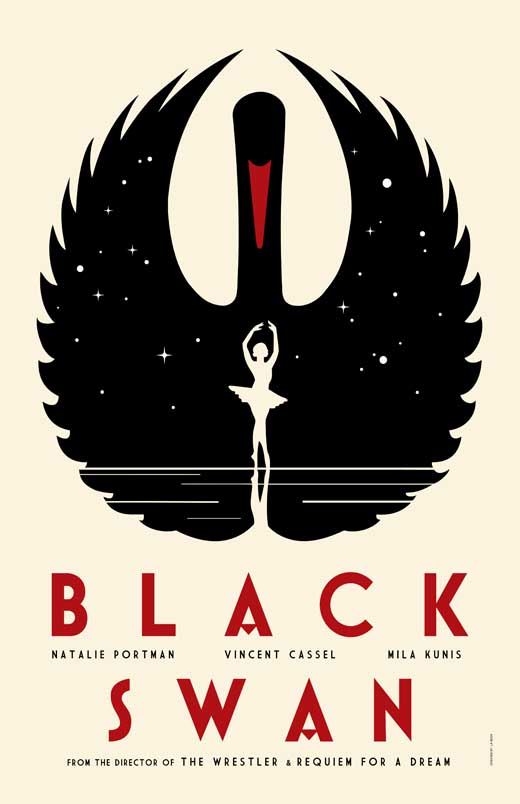
Black Swan


Natalie Portman plays Nina Sayers, a ballet dancer who gets her break when she is cast as the lead in Swan Lake by company director Thomas Leroy (Vincent Cassel). Nina initially can play the White Swan role in the ballet perfectly, but being able to play the Black Swan requires her to "let go" of herself during her dancing. However, as she "lets go" during performances, she also finds herself letting go of life generally, and (quite literally) becoming the Black Swan.

From very early on Nina discovers scratches on her back (the beginnings of wings), and her skin occasionally ripples with a poultry-like texture! Psychologically, having been raised by an overbearing mother (a failed dancer), Nina finds herself rebelling slightly; wanting privacy at home, going out drinking late with fellow dancer (and understudy for lead Swan) Lily (Mila Kunis). She also starts begins to fantasize, having sex with Lily, and imagining that Lily is trying to get Nina out of the picture so that she can have the title role. This culminates in the final performance when Nina believes that she has stabbed Lily to death in her changing room. Nina then dances the Black Swan perfectly, but before the show's climax realises that she has not stabbed Lily but herself! In the final act of the ballet when the White Swan jumps to her death, the gut wound she inflicted on herself is suddenly obvious and Nina dies having finished the "Perfect" dance.

I don't know anything about ballet, and did not know the story of Swan Lake, though a very neat summary is given by Vincent Cassel towards the beginning of the film. Natalie is very good, I'm not familiar with all her work but I guess this could be her biggest lead role, and she carries it very well; completely erasing any Star Wars doubts. She did have a major role in V for Vendetta, where I also thought she was very good, but it wasn't really her film; and I'm not sure about Closer as I haven't seen it. Black Swan perhaps is her most mature performance, proving that she can cope with demanding roles.

Vincent Cassel has an influential role, but not a major role; yet still seems to have quite an off-screen presence that drives Natalie's character in a particular direction. It was slightly disorientating seeing him in this because I am half way through watching Mesrine: Killer Instinct, in which Vincent Cassel plays a notorious French gangster. My review will follow later as there are actually 2 parts to the film, and I've only watched the first. Consequently, the confusion remains: French Gangster, or Ballet instructor?!

Technically, Darren Aronofsky like using mirrors in this film. A lot. It does work, showing the two sides of Nina's character and how it is becoming fractioned and disjointed. Most obviously of course when dancing in the studio, and the reflection of Nina continues dancing for just second after she has actually stopped dancing. I did think on occasion that half of the special effects budget must have been spent on removing the reflections of the camera crew as Natalie danced around the studio in front of loads of mirrors!

(A fly on the wall watches Natalie get ready)

Actually, there are scenes demonstrating Nina's transformation to a Swan, where she pulls at a raggedy finger nail and rips a huge bit of skin off her finger! Very reminiscent of Brundle-fly! Seeing Natalie dressed like this reminds me; near the beginning of the film there is a shot from the stands of the studio looking down on all the dancers training as Vincent Cassel approaches; really reminded me of Enter the Dragon as the competitors first arrive on Han's Island and they look down on hundreds of people practising their Kung Fu! Mmmm. There were lots of mirrors used there too!


Anyway! Russ recommends seeing it. Black Swan that is. Possibly even deserving of an Academy Award. Also see Enter the Dragon if you haven't!

Thursday, December 16, 2010

Distant Relatives: The Entertainer and The Wrestler


Robert here, with my series Distant Relatives, where we look at two films, (one classic, one modern) related through a common theme and ask what their similarities and differences can tell us about the evolution of cinema. 


Angry Old Men 

As a society we have such a strange relationship with celebrities.  We admire them and we despise them.  We love when they fail, embarrassing humiliation and then we promise to celebrate their comeback.   For the person who has actually attained fame, there's a good chance that that fame will come to an end before they do.  At some point society won't have a place for them anymore.  Filmmakers seem naturally attracted to the stories of these people since their world, for good or bad, is eternally rooted in the hype of fame.


Tony Richardson's The Entertainer and Darren Aronofsky's The Wrestler are two outside-of-Hollywood films with two very outside-of-Hollywood subjects.  Archie Rice of the somewhat-forgotten (or at least under-loved) The Entertainer is an old music hall performer, a song and dance man in a world where rock and roll is the only song and dance anyone seems to care about any more.  His audience is small and unenthusiastic.  Randy the Ram's audience is enthusiastic.  He's got small crowds cheering for him every week as he makes the rounds of the local underground wrestling scene.  The audience cheers for blood and bruises.  They cheer for Randy out of nostalgia for a time when Randy had full arenas packed just to see him entertain.

See the Resurrection

Two men trying desperately to hold onto a time when they mattered, growing old, living paycheck to paycheck or not even.  At the start Randy seems to have a better deal.  He's at least part of a community (though most of his fellow underground wrestlers are young guys trying to get where he once was), he has a haunt in the local strip club and a tenuous connection with fellow over-the-hill dancer Cassidy.  Living in a trailer park isn't preferred but he plays with the local kids and he has people who cheer for him.  Archie Rice does not.  And while he can often be found throwing one or many back among laughing cohorts, it's an attempt to recapture the good old days and numb the present ones.  They are not really his friends.  Both men are estranged from their families with particular attention payed to their relationships with their daughters.  Archie's is sympathetic but disappointed.  Randy's is jaded.  The father/daughter relationship is often plastered with "daddy's little girl" cliches.  Maybe we're meant to think that here, or maybe not.  Certainly we're given a glimpse into what could be.

Naturally there's a comeback opportunity that is not to be.  It seems unfair to breeze over the big chance for these men but it's a foregone conclusion that it can never be.  The entertainment industry demands change or death and these men, so desperate to matter again, aren't evolving but trying to pull their worlds back into the past with them.  Then again, the evolution that the world demands of these men is far from ideal.  Archie's best prospects are in Canada where he has an opportunity to run a hotel.  For Randy it's the deli counter of his local grocer, waiting on grumpy, particular seniors.  It's no surprise that Randy chooses to put his health at risk to fulfill his comeback, just as Archie stakes his financial future and risk of prison time on his.  The choice that these men have really isn't a choice at all.

We Had Faces Then


There is one woman whose shadow looms large over these two men.  She is the patron saint of washed up performers, or perhaps since we're talking in terms of relatives, their mother.  Norma Desmond is the original doomed performer though she's a villain; as time goes on, these characters get more and more tuned to our sympathies.  Desmond is such a villain that her film needs a hero.  Archie Rice isn't a villain but he's quite hurtful to those who love him.  He's given up trying.  Randy the Ram too screws up and often, but we get the sense that he's trying, he just can't overcome his own nature.

Randy's likability and the severity of his ultimate fate presents us with the biggest emotional blow of any of these characters.  Perhaps as time goes on, these kinds of stories must get more painful to make us take notice.  Or perhaps writer Robert Siegel has noticed how fatalistic celebrity culture has become.  All three films inhabited by these characters end with a death.  Perhaps it's the death of hype, or old Hollywood or British reign (as has been speculated in the case of The Entertainer).  Either way, the past dies.  And so does the roar of the crowd.